A private vehicle sale moves money in seconds and paperwork in days. Almost everything that goes badly wrong in a Canadian private sale lives in that gap—and almost all of it is discoverable in advance, for less than the cost of a tank of fuel.
This is what has to be checked, in what order, and why the answer changes depending on which province the vehicle has actually lived in.
A registered lien attaches to the vehicle, not to the seller
This is the single most expensive misunderstanding in private vehicle sales, and it is worth stating plainly: if a lender has registered a security interest against a vehicle, that claim does not disappear when the vehicle changes hands. Ontario’s own guidance is blunt about the consequence—a lien claimant has a right to the vehicle, or to the amount of the lien from the buyer, once the transfer is completed.
So a buyer can pay in full, register the vehicle, insure it, drive it for a year, and still lose it to a creditor who was never paid. “The seller told me the loan was paid off” is not a defence. In Quebec the point is made in law: a right registered in the RDPRM is deemed to be generally known, and a buyer who did not consult the register cannot argue they were unaware of it.
A lien search is the cheapest insurance in the transaction. It costs a few dollars and takes minutes.
Where the lien actually lives, province by province
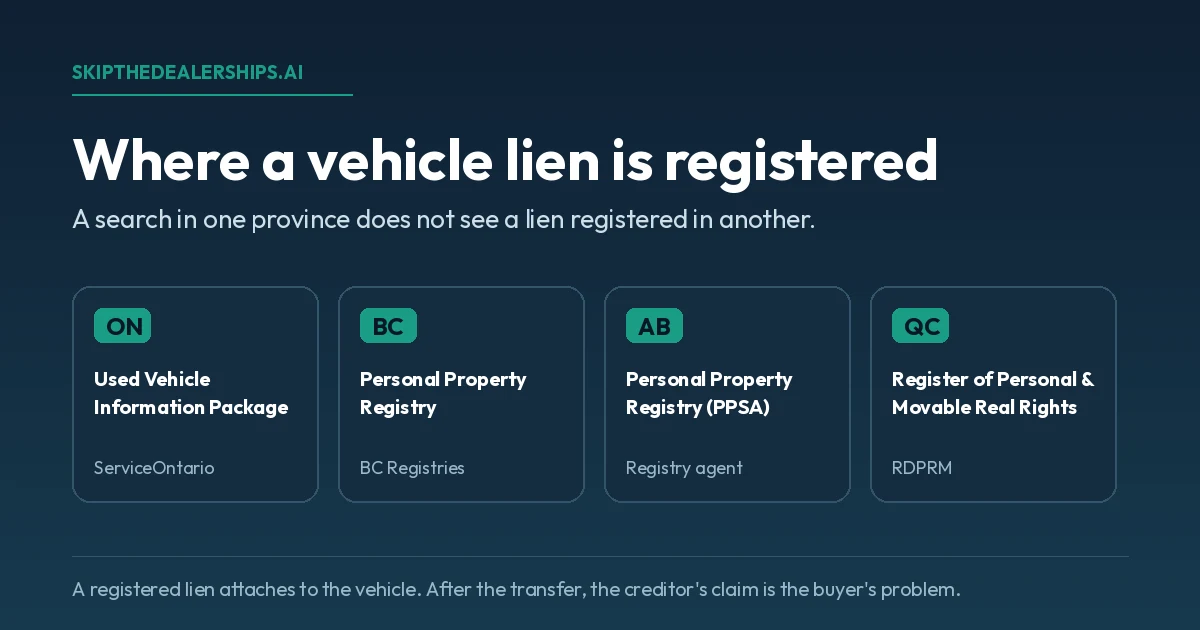
There is no national vehicle-lien registry in Canada. Each province maintains its own, and each has its own front door.
| Province | Lien search | Tax on a private sale | Where the transfer happens |
|---|---|---|---|
| Ontario | Liens registered in Ontario appear in the Used Vehicle Information Package | Retail sales tax on the purchase price or the Canadian Red Book wholesale value in the package, whichever is higher | ServiceOntario, generally within six days of the sale |
| British Columbia | BC Registries Personal Property Registry, searched by VIN | Provincial sales tax on the declared price or ICBC’s average wholesale value, whichever is higher, at rates that step up for higher-value vehicles | Transfer/Tax Form (APV9T) to an Autoplan broker within 10 days of the sale |
| Alberta | Personal Property Registry — the registry agent runs the search as part of the transfer | No provincial sales tax on a private sale | Any registry agent, with the signed bill of sale, photo ID and proof of insurance |
| Quebec | Register of Personal and Movable Real Rights (RDPRM), searched by VIN | Quebec sales tax on the agreed price or the estimated value, whichever is higher | An SAAQ outlet with both parties present and photo ID, or online through SAAQclic |
Ontario is the outlier in a useful way. The seller is legally required to give the buyer a Used Vehicle Information Package, and failing to do so is an offence carrying fines that start at $100 for a first offence. The package pulls the vehicle’s Ontario registration history, its Canadian Red Book average wholesale value and any liens registered in Ontario into one $20 document. A private seller who has not bought one is not ready to sell.
Alberta builds the check into the counter: the registry agent runs the search as part of the transfer, and a lien that surfaces stops the transfer until it is discharged. That is a real protection, but it arrives late—after the buyer has usually already paid.
A lien registered in another province will not appear in your province’s search
This is the gap that catches careful buyers, because they did check—they simply checked one registry.
Vehicles move across provincial lines constantly, and a security interest registered where the loan was written stays registered there. A vehicle financed in Alberta, driven east and advertised in Ontario can carry an Alberta registration that an Ontario package was never going to show, because the Ontario package reports liens registered in Ontario.
The practical rule: search the registry of every province the vehicle has been registered in, not only the one you are standing in. A national vehicle-history report is a useful complement for exactly this reason—it aggregates across jurisdictions—but treat it as a complement, not a substitute. The provincial registry is the authoritative record; the report is a commercial summary of what it could find.
The tax is calculated on a number the two of you do not choose
Buyers and sellers routinely assume that the figure written on the bill of sale sets the tax. In most of the country it does not.
Ontario charges retail sales tax on the purchase price or the Canadian Red Book wholesale value shown in the information package, whichever is higher. British Columbia charges provincial sales tax on the declared price or ICBC’s average wholesale value for that vehicle, whichever is higher, collected by the Autoplan broker at transfer, with rates that step up for higher-value vehicles. Quebec charges its sales tax on the agreed price or the estimated value, whichever is higher, collected by the SAAQ. Alberta charges no provincial sales tax on a private sale at all.
The consequence is worth being direct about: writing a lower price on the bill of sale does not lower the tax. It produces a false document, and it leaves the buyer holding a receipt that understates what they actually paid—which is the document they would need if the sale were ever disputed, or if an insurer asked what the vehicle cost.
If the price genuinely is below book value—high kilometres, accident history, a vehicle sold as-is—that is a conversation to have with the province, supported by evidence, not something to solve with a smaller number on a form.
The safety certificate proves less than people think
In Ontario a Safety Standards Certificate is what lets the buyer plate the vehicle, outside narrow exemptions such as a transfer between spouses. It confirms the vehicle met the province’s minimum safety standards at the time of the inspection.
It is not a warranty, not a condition report, and not a statement that the vehicle is a good one. A vehicle can pass a safety inspection with a failing transmission, a rusted body, deferred maintenance and an accident history. The certificate and an independent pre-purchase inspection answer completely different questions, and only one of them is about whether you should buy the car.
The clock starts at the handshake
Transfer deadlines are short and they are the buyer’s problem more often than the seller’s. Ontario buyers generally have six days to register. British Columbia expects the completed Transfer/Tax Form at an Autoplan broker within 10 days of the sale. Quebec requires both parties at an SAAQ outlet with photo identification, or a transfer through SAAQclic if both are registered on it. Alberta requires the buyer at a registry agent with the signed bill of sale, identification and proof of insurance.
The seller’s exposure runs the other way. Until the transfer is recorded, the vehicle is still associated with them. In most provinces the plates belong to the registrant rather than to the vehicle, so they come off before the buyer drives away—and a seller who lets a buyer leave on their plates and their registration has handed a stranger their liability.
What a bill of sale has to carry
Alberta’s registry agents work from a standard bill of sale, and its contents make a sound minimum anywhere in the country:
- The vehicle identification number, read off the vehicle itself
- Year, make, model and colour
- The odometer reading on the day of the sale
- The actual sale price
- The date of the sale
- Full names, addresses and signatures of both the buyer and the seller
Both sides keep a signed copy. A bill of sale that exists only on the buyer’s phone is not much use to the seller when a question arrives eight months later.
The order that protects both sides
Sequence matters more than any single document, because each step is cheap while the one before it has not been passed:
- Read the VIN off the vehicle—the dash and the door jamb—and confirm it matches the registration document the seller is holding.
- Search the lien registry in every province the vehicle has been registered in, using that VIN.
- Pull a vehicle-history report and read it against what the seller told you.
- Pay for an independent pre-purchase inspection, chosen by you, not recommended by the seller.
- Agree the total cost—price, tax, transfer fees, immediate repairs—rather than the advertised number.
- Pay traceably. If cash changes hands, it changes hands against a signed receipt naming the amount and the vehicle.
- Complete the transfer at the counter, together, not in the driveway afterwards.
If the vehicle still carries a loan, the money goes to the lender, not to the seller. Pay the balance directly, get the discharge, and transfer once the registry shows the vehicle clear. Handing the payout to a seller and trusting the discharge to follow is how buyers end up owning a car and a stranger’s debt.
Why any of this is the marketplace’s problem
Every step above is something a private buyer can do alone, and most never do—not because they are careless, but because the sequence is invisible until something has already gone wrong. The information is public. It is simply scattered across four registries, two tax authorities and a stack of provincial forms.
That is the gap SkipTheDealerships.ai is being built to close: not to replace the registries, but to make sure nobody reaches the payment step before the checks that protect them have actually happened.
Put verification before payment
SkipTheDealerships.ai is being built around a more transparent approach: helping Canadians connect directly, compare vehicle information and make decisions without allowing the transaction to outrun verification.
Sources
- Government of Ontario: Used Vehicle Information Package
- Government of Ontario: Safety Standards Certificate
- Province of British Columbia: Personal property liens and searches
- Province of British Columbia: PST on vehicles (Bulletin PST 308)
- ICBC: Transfer/Tax Form (APV9T)
- Government of Alberta: Buying a vehicle from a private seller
- Government of Alberta: Personal property liens
- Québec: Register of Personal and Movable Real Rights (RDPRM)
- SAAQ: Transferring a vehicle between individuals
This article is general information, not legal or tax advice. Requirements, rates, fees and deadlines differ between provinces and territories and change over time. Buyers and sellers should confirm the current requirements with the province or territory where the vehicle is being transferred.