Canadians waiting for used-vehicle prices to drop finally have evidence that the market is moving in their direction—but not enough evidence to assume every vehicle is now a bargain.
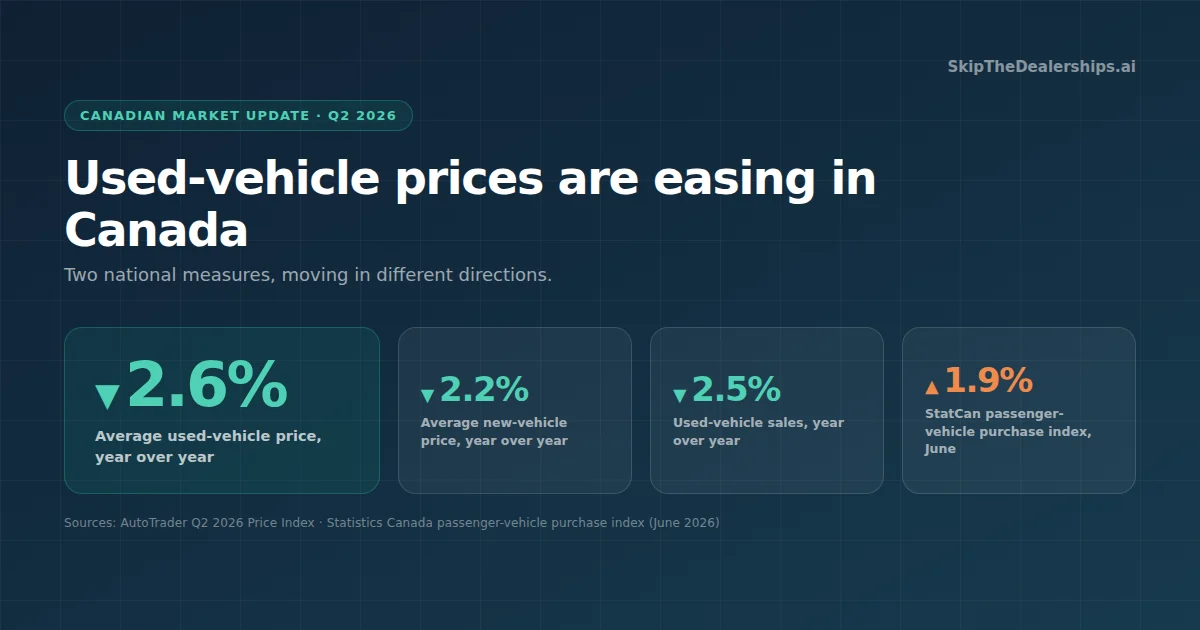
AutoTrader’s second-quarter 2026 Price Index reported that average used-vehicle prices declined 2.6% compared with the same quarter in 2025. Average new-vehicle prices fell 2.2%. Used-vehicle sales also declined 2.5% year over year during the quarter, although AutoTrader reported that both new- and used-vehicle sales increased in June.
Meanwhile, Statistics Canada reported that its passenger-vehicle purchase index was still 1.9% higher in June 2026 than a year earlier, although that annual increase had slowed from 2.5% in May.
Those findings are not contradictory. They measure the market differently, but together they point toward a Canadian vehicle market that is cooling gradually—not collapsing.
Why a 2.6% national decline does not settle the price
An average combines thousands of vehicles across multiple categories and locations. Your result depends on the exact vehicle you are considering.
A three-year-old compact sedan in a major urban market may face different supply and demand than a late-model pickup in a northern community. Fuel-efficient vehicles, work trucks, hybrids, electric vehicles and recreational units can each move differently from the national average.
Regional transportation costs also matter. Buyers in remote and northern communities may have fewer comparable vehicles nearby and may need to include shipping in the total cost. A vehicle advertised for less in another province is not necessarily less expensive after inspection, transportation, registration and tax requirements are added.
The national decline is therefore a useful negotiating signal, not a guaranteed discount.
What buyers should do differently now
A softening market gives buyers more reason to compare before committing. It does not remove the need for due diligence. Start by comparing vehicles with the same model year and trim, approximate kilometres, powertrain, drivetrain, equipment, accident history, location and overall condition.
Do not compare a rebuilt vehicle with a clean-title vehicle or a high-kilometre former fleet unit with a privately owned low-kilometre example and conclude that one seller is overpriced.
Buyers should also track how long a vehicle has been advertised. A recent listing may leave little room for negotiation, while a vehicle that has remained unsold through several price changes may give the buyer more leverage.
Most importantly, negotiate the total transaction—not only the advertised price. Financing charges, taxes, inspections, transportation, immediate repairs and existing liens can materially change the result.
Falling prices can hide expensive financing
A lower purchase price does not automatically produce a lower total cost. A buyer saving $1,500 on the vehicle could surrender that advantage through a higher borrowing rate, an unnecessarily long loan or optional products added to the financing. Monthly-payment negotiations can make an expensive transaction appear affordable by extending the repayment period.
Before accepting financing, ask for the vehicle’s actual purchase price, the interest rate, the total borrowing cost, the loan term, the payment frequency, every optional product and the total amount payable over the full agreement.
Compare the complete cost with at least one alternative financing option. A falling vehicle market strengthens the buyer’s position only if the financing does not take the savings back.
What the market shift means for private sellers
Sellers should not interpret the national price decline as a reason to underprice a good vehicle immediately. Instead, use multiple current comparables from the same region and category. Adjust for kilometres, condition, accident history, maintenance records, tires and equipment. Asking prices are useful, but they do not prove what similar vehicles actually sold for.
Buyers now have more evidence to challenge unrealistic prices. A listing supported by a vehicle-history report, service documentation, clear photographs and an independent inspection may defend its value better than a cheaper listing with unanswered questions.
If inquiries are weak, review the price before paying to promote the advertisement. The problem may be an inflated asking price, but it could also be poor photographs, missing information or a lack of trust.
Is this the right time to buy or sell?
For buyers, easing prices and softer demand create an opportunity to compare more carefully and negotiate from evidence. Waiting may produce a lower price on some vehicles, but the most desirable examples can still sell quickly.
For sellers, the market remains active, but pricing from last year may no longer attract the same response. Accurate local comparables and strong documentation matter more as buyers become selective.
Neither side should make a decision from one national percentage. The better approach is to combine Canadian market direction with the history, condition, financing and local demand for the exact vehicle.
Put verification before payment
SkipTheDealerships.ai is being built around a more transparent approach: helping Canadians connect directly, compare vehicle information and make decisions without allowing the transaction to outrun verification.
Sources
- AutoTrader Canada: Q2 2026 Automotive Price Index
- Statistics Canada: Consumer Price Index, June 2026
- Statistics Canada: Transportation price-index table
National averages do not determine the value or condition of an individual vehicle. Buyers and sellers should independently verify vehicle information and applicable provincial or territorial requirements.