Ask a Canadian what their car cost and many will answer with a monthly payment. That is not an accident of language. It is the number the transaction is organised around—and it is the one number that can be improved without making anything cheaper.
Every dollar of that difference is knowable before you sign. Here is the arithmetic, and the questions that surface it.
The same car at five different prices
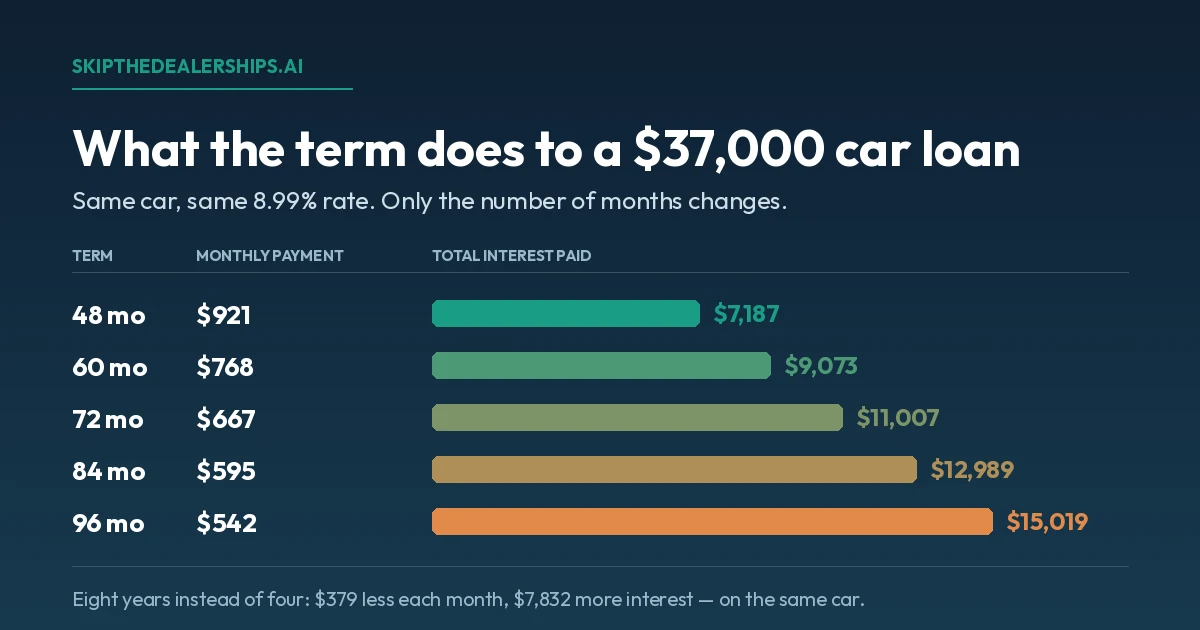
Take $37,000 financed at 8.99%—roughly the average new auto loan Equifax Canada reported for the second quarter of 2026. Change nothing except the number of months:
| Term | Monthly payment | Total interest | Total paid |
|---|---|---|---|
| 48 months | $921 | $7,187 | $44,187 |
| 60 months | $768 | $9,073 | $46,073 |
| 72 months | $667 | $11,007 | $48,007 |
| 84 months | $595 | $12,989 | $49,989 |
| 96 months | $542 | $15,019 | $52,019 |
Eight years instead of four saves $379 every month and costs $7,832 more in interest. The more common trade—84 months instead of 60—saves $173 a month and costs $3,916.
Nobody is being deceived by these numbers. They are simply never the numbers under discussion, because the conversation is about what fits a monthly budget, and on that question the long term always wins.
The total cost of borrowing is a number you can ask for
Canadian lenders do not get to keep this quiet. Cost-of-credit disclosure has been harmonised across the provinces and territories, and federally regulated lenders have their own disclosure obligations: the borrower is entitled to see the annual percentage rate, the term, the payment schedule and the total cost of borrowing expressed as an amount, before the agreement is made.
The annual percentage rate is the one to ask for by name. It is not always the same as the interest rate: where fees form part of the cost of credit, the APR reflects them and the posted interest rate does not. Two offers at “the same rate” can carry different APRs, and the APR is the one that answers what the money costs.
So the question that ends the monthly-payment conversation is short: what is the total amount payable over the full agreement? One number, disclosed, comparable between offers.
Long terms and negative equity travel together
A vehicle loses value fastest in its early years, while a long loan repays principal slowest in exactly that period. The two curves cross, and for a while the borrower owes more than the vehicle is worth. That is negative equity, and it is the mechanism—not the misfortune—behind most of the trouble.
Return to the 84-month loan above. Four years in, the borrower has paid $28,565 and still owes $18,717. That is $47,282 committed on a $37,000 vehicle that is now four years old—and four years is precisely when many people start thinking about replacing it.
The Financial Consumer Agency of Canada has been warning about this pairing for a decade. Its 2016 research on auto finance found that the share of consumers trading in while in a negative equity position had risen from 20% in 2010 to 30% in 2015, and identified terms beyond six years as a specific risk to Canadian borrowers.
What happens when the shortfall is rolled forward
A buyer who is $6,000 underwater and wants a different vehicle is usually offered the obvious solution: the shortfall is added to the new loan. Nothing is written off. The new loan is larger than the new car, interest is charged on the whole of it, and the starting position on the next vehicle is worse than the last.
FCAC is direct about where that ends—there are limits on how many times a negative position can be carried forward before a borrower starts facing restrictions on obtaining financing at all. The cycle is finite. It just does not announce which transaction was the last one.
Add-on products are financed too
Extended warranties, protection packages and similar products are usually presented as a small change to the payment, which is accurate and beside the point. A $2,000 product financed at 8.99% over 84 months adds about $32 a month—and $2,702 to the total, because $702 of interest is charged on it over seven years.
That is not an argument against buying one. It is an argument for pricing it as $2,702 rather than as $32, and for deciding whether it is worth that before it is folded into a payment where it becomes invisible.
Arrange the financing before you choose the car
Financing arranged through a seller is a product being sold to you, not a service being performed for you. The arranger may be compensated for placing the loan, and the rate presented is not necessarily the best rate you qualify for—FCAC has been consulting on supervisory expectations for exactly this indirect-lending channel.
The defence is unglamorous and works: get a pre-approval from your own bank or credit union first. It costs nothing, it tells you what you actually qualify for, and it turns the financing conversation into a comparison instead of a negotiation. If the seller beats it, take theirs. You will only know that they did if you brought a number with you.
The questions worth asking out loud
- What is the vehicle’s price, separate from anything else in this agreement?
- What is the annual percentage rate, and what is the interest rate?
- How many months, and how often are payments taken?
- What is the total cost of borrowing, in dollars?
- What is the total amount payable over the full agreement?
- Which optional products are included, what does each cost, and what is each worth?
- Is there a penalty for paying the loan out early?
- Is there an existing loan on my trade-in, and how much of it is being carried into this one?
If a question cannot be answered before signing, that is the answer.
The same arithmetic applies to a private sale
Private buyers borrow too—usually from their own bank or credit union rather than at the point of sale—and every number above behaves identically. The advantage is that the financing conversation and the vehicle conversation are separated by default, which is most of the protection.
The rest of it is documentary. If the vehicle you are financing still carries someone else’s loan, the lien travels with the car and becomes your problem after the transfer — which is a separate piece of homework worth doing before any money moves. And a softening price market only helps the buyer if the financing does not quietly take the saving back.
Put verification before payment
SkipTheDealerships.ai is being built around a more transparent approach: helping Canadians connect directly, compare vehicle information and make decisions without allowing the transaction to outrun verification.
Sources
- Financial Consumer Agency of Canada: Financing a car
- Financial Consumer Agency of Canada: Financial risks when buying a car
- Financial Consumer Agency of Canada: Shopping around for auto-financing
- Financial Consumer Agency of Canada: Risks of extended-term car loans (2016 research, Auto Finance: Market Trends)
- Financial Consumer Agency of Canada: Personal loans — know your rights
- Financial Consumer Agency of Canada: Consultation on the proposed bulletin on indirect auto loans
- Consumer Measures Committee: Agreement for Harmonization of Cost of Credit Disclosure Laws in Canada
- Equifax Canada quarterly credit trends, reported by Auto Remarketing Canada
This article is general information, not financial advice. The payment and interest figures are illustrative amortisations at a stated rate, not an offer, a quote or a prediction of the rate any borrower will be given. Rates, terms and eligibility differ by lender and by borrower.